The origin of the 220 PeV neutrino event KM3-230213A
First figure
Second figure

Ultrahigh-energy cosmic-ray signature in GRB 221009A
My figure
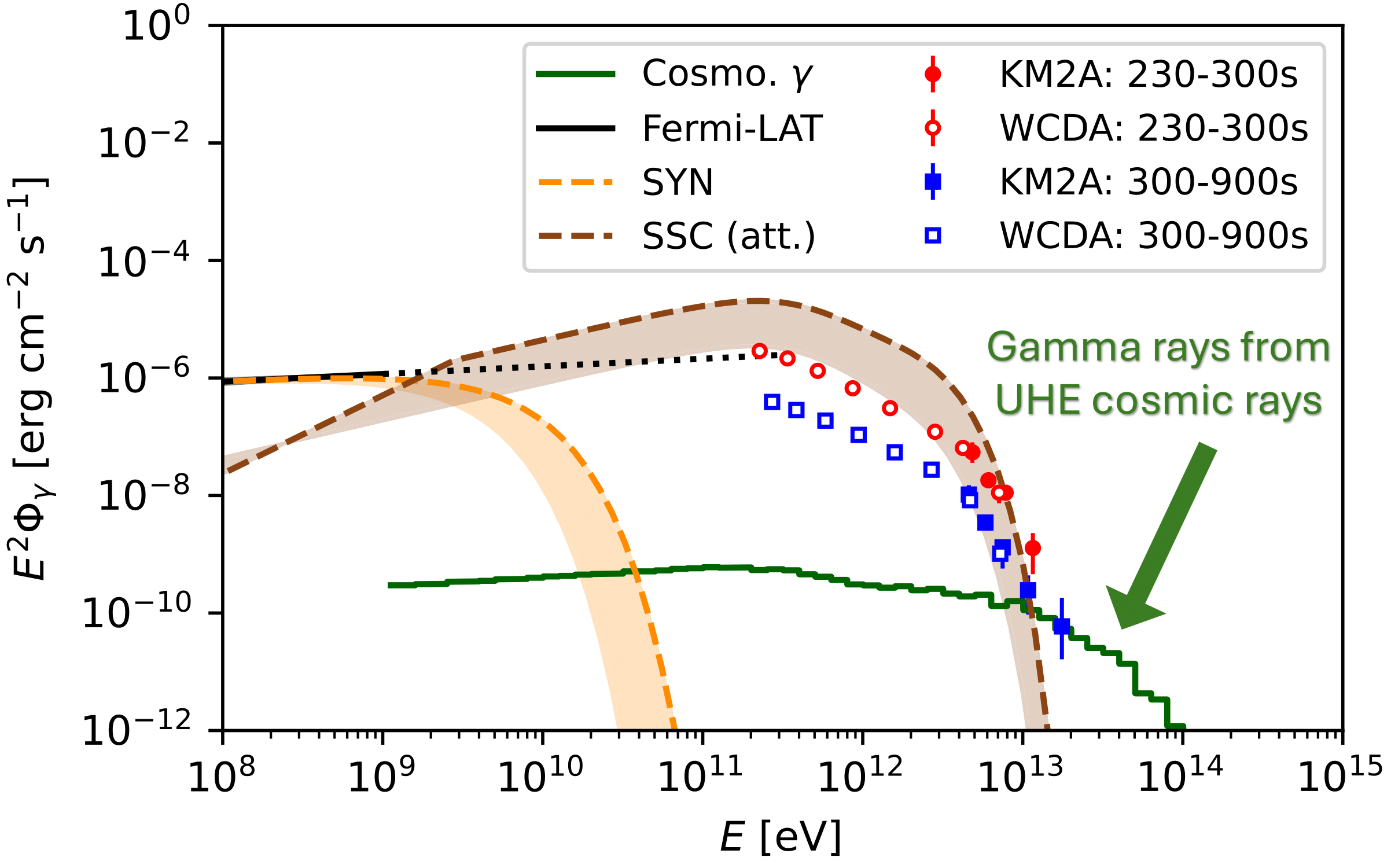
Gamma-ray bursts (GRBs) are the most luminous explosions in the universe, but the origin of high-energy \(\gamma\)-rays in these events has long been ambiguous. Following the Fermi-LAT detection of the brightest GRB 221009A and the unprecedented observation of >10 TeV photons by LHAASO we demonstrated that cosmic-rays accelerated in the afterglow phase can escape and interact with cosmic background photons along the line of line-of-sight to produce these multi-TeV gamma rays. Electron radiation processes cannot explain these high-energy gamma rays coming from the distant universe since they are absorbed. This implies cosmic rays can be accelerated up to \(10^{20}\) eV. The energy required in cosmic rays is a fraction of the energy released in the explosion. The figure shows the \(\gamma\)-ray spectrum of GRB 221009A showing high-energy observations. Synchrotron and synchrotron self-Compton emission are shown by orange and brown shaded regions.


Two-population model of ultrahigh-energy cosmic rays

First figure
Second figure

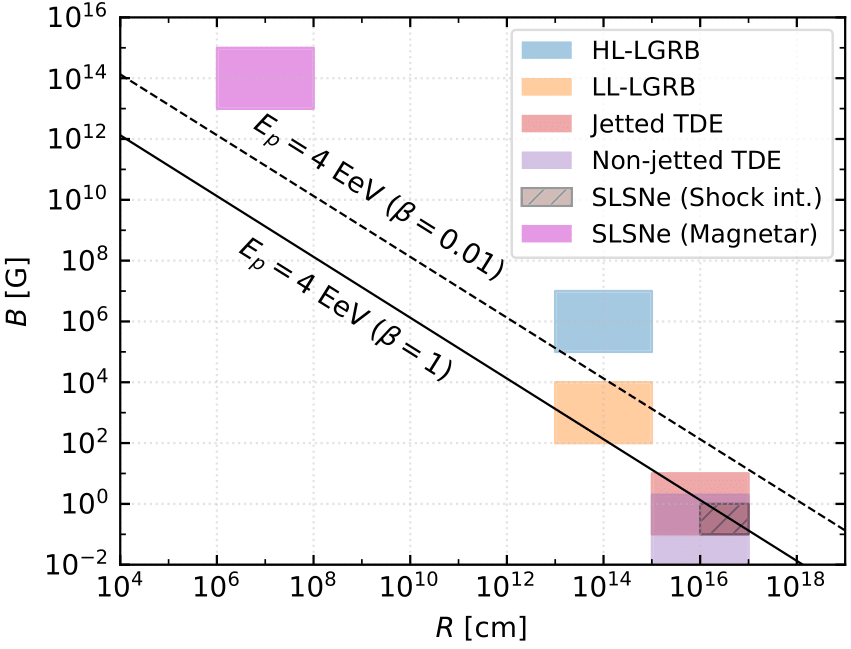
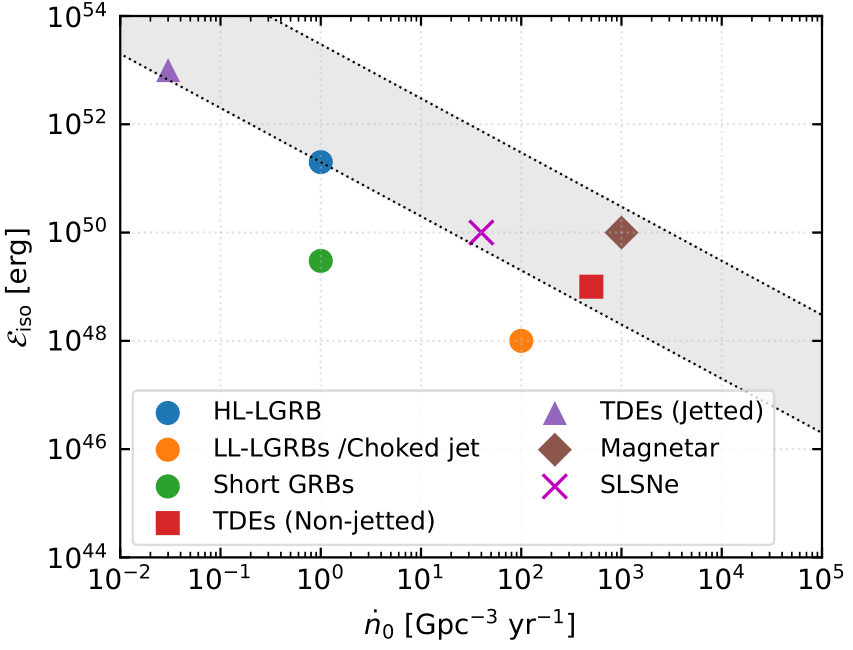
We used CRPropa simulations we developed a two-population model of extragalactic sources to explain the latest Pierre Auger Observatory data on ultrahigh-energy cosmic rays (UHECRs). In our framework, one source population accelerates protons to the highest observed energies, while another accelerates heavier nuclei with lower cutoff energies. This combined model reproduces both the observed UHECR spectrum and composition more successfully than single-population scenarios. We also calculated the cosmogenic neutrino fluxes expected from these sources, finding that next-generation observatories will be able to test the predictions of this hybrid-source picture. Our results provide new insights into the interplay between cosmic-ray composition, acceleration environments, and multi-messenger signatures.