Cosmic rays and neutrinos
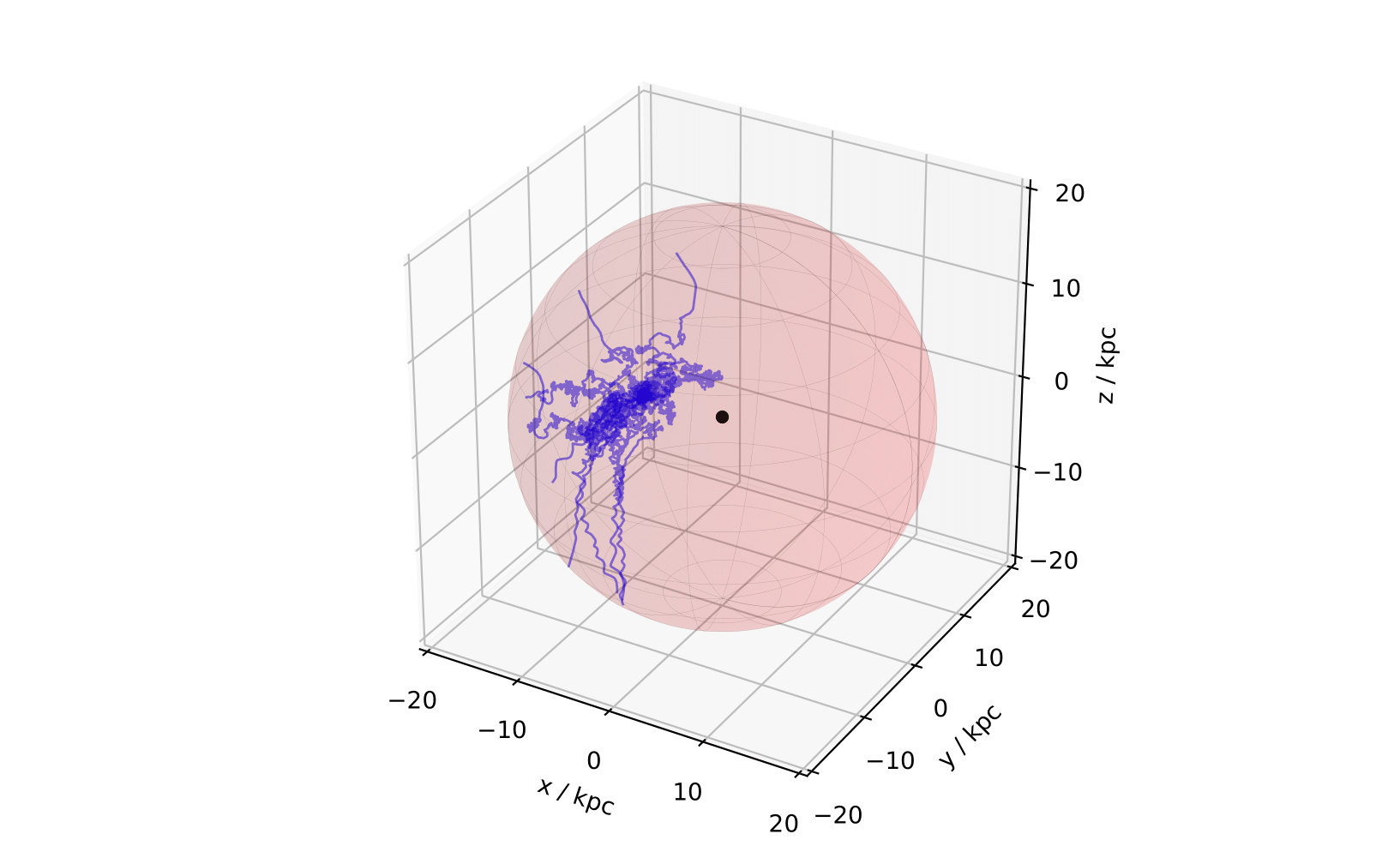
The image shows trajectory of a few cosmic rays of energy 1 EeV in the Galactic magnetic field (Das et al. 2020 ApJ). The black and blue dots are the Galactic center and Earth respectively.
I am an astrophysicist with expertise in time-domain and multi-messenger studies of high-energy phenomena, and I also investigate cosmic-ray acceleration in magnetized turbulence using particle-in-cell (PIC) simulations. Our knowledge of the universe has long relied on the observation of light—such as staring at the stars in the night sky—but photons are only one of the four messengers. Together with cosmic rays, neutrinos, and gravitational waves, they provide a more complete understanding of extreme astrophysical environments. My research aims to uncover the mechanisms that accelerate cosmic rays and to trace their imprints, thereby revealing the connections between compact objects, luminous gamma-ray sources, and multi-messenger signals.
To address these problems, I employ large-scale simulations of cosmic-ray acceleration and extragalactic propagation on high-performance computing platforms, using advanced numerical methods. Over the years, my work has focused on these central themes:
The image shows trajectory of a few cosmic rays of energy 1 EeV in the Galactic magnetic field (Das et al. 2020 ApJ). The black and blue dots are the Galactic center and Earth respectively.
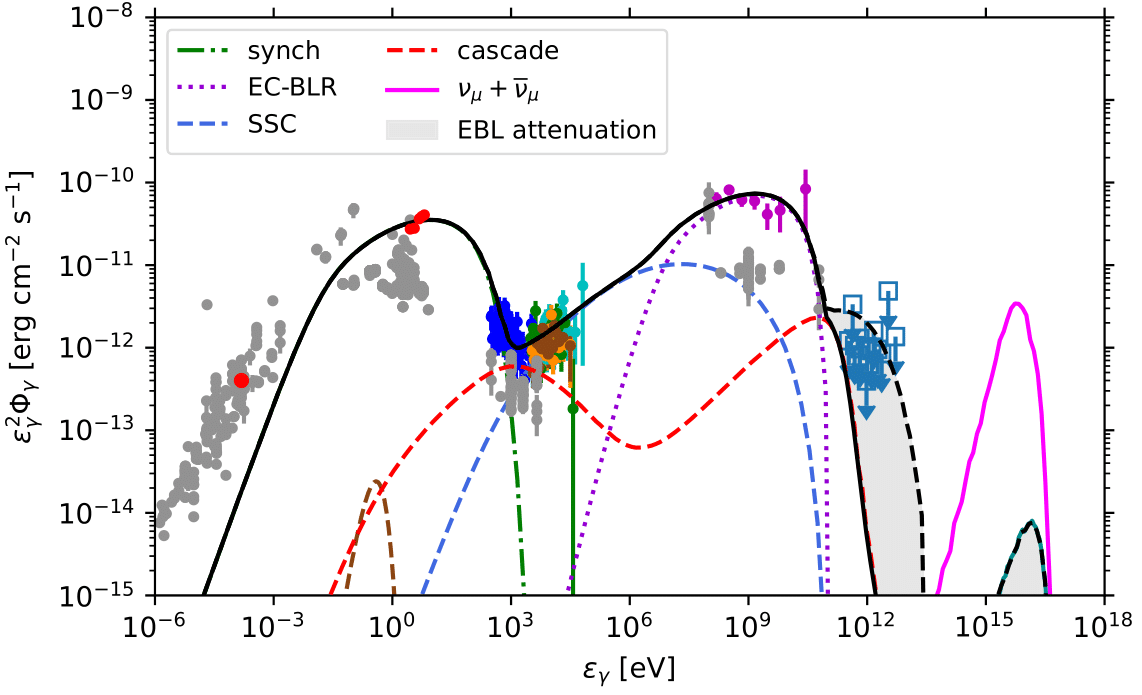
Multiwavelength spectral energy distribution of